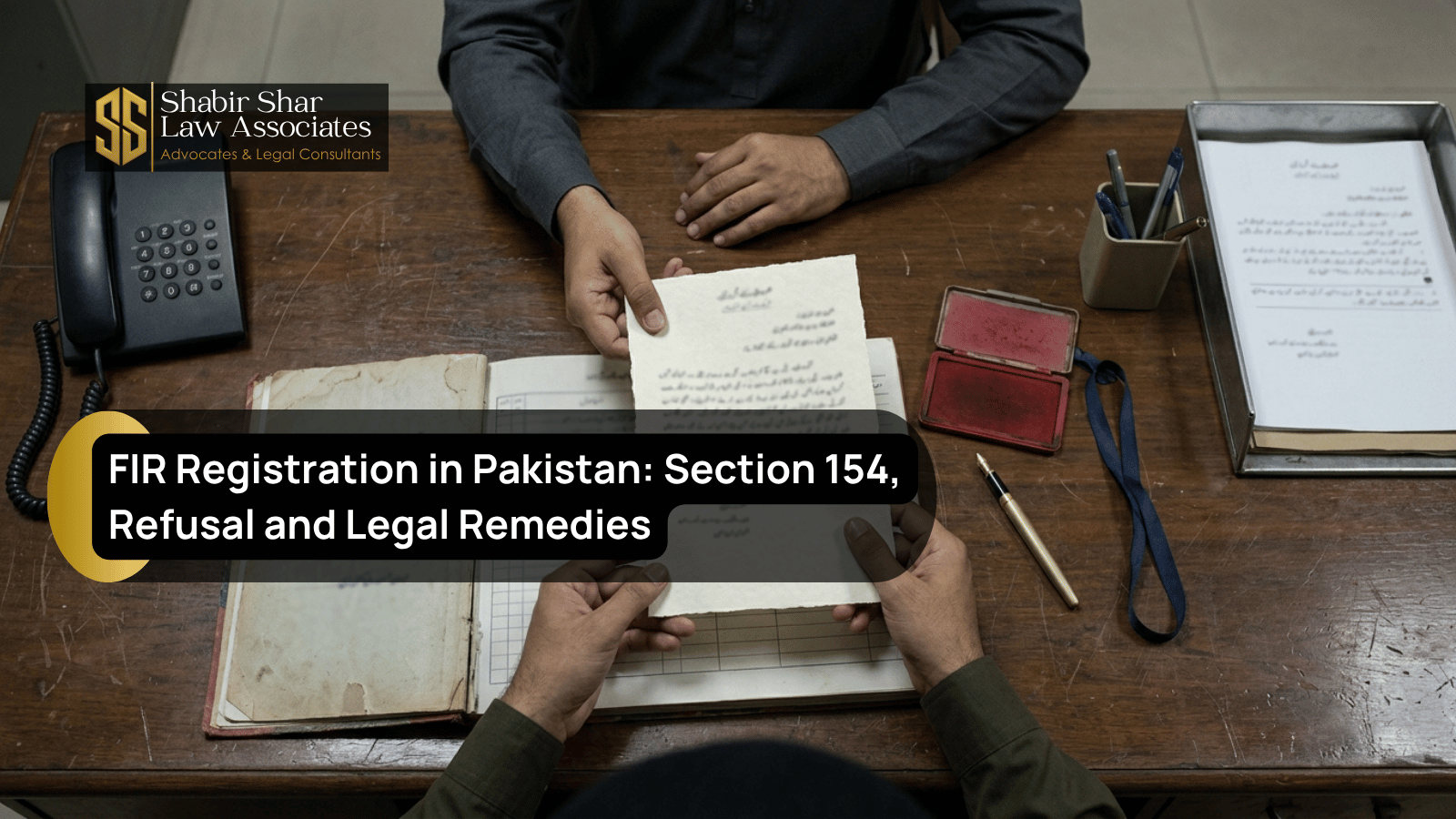
FIR Registration in Pakistan: Complainant Rights and Police Duties
A supporting guide to the complainant's practical rights when reporting a cognizable offence, including recording, a free FIR copy and remedies for police non-registration.

Complainant Rights During FIR Registration
Section 154 of the Code of Criminal Procedure, 1898 sets out the basic process when information relating to a cognizable offence is given to the officer in charge of a police station. Oral information is to be reduced to writing, read over to the informant and signed, and the substance is entered in the prescribed record.
This supporting article focuses on the complainant's procedural position. Our main guide to the full registration process and legal remedies is Registration of FIR in Pakistan: Procedure and Legal Remedies.
Give a Clear Factual Account
The information should identify the occurrence as clearly as reasonably possible: what happened, where and when it happened, the persons involved if known, and the facts showing a cognizable offence. An FIR is the beginning of investigation, not the final proof of the accusation, so the informant should avoid speculation and distinguish personal knowledge from information received from others.
Recording and Copy of the FIR
Where section 154 applies, the information is recorded in writing and read back to the informant before signature. The complainant should check names, dates, locations and the substance of the allegation carefully. A copy of the recorded FIR should be obtained through the lawful process and retained with any complaint or supporting record.
What If Police Do Not Register the Case?
Section 22-A(6) CrPC gives an ex-officio Justice of the Peace power to issue appropriate directions to police authorities on complaints regarding non-registration of a criminal case, transfer of investigation, and neglect, failure or excess by police in relation to their functions and duties. The remedy is therefore associated with the ex-officio Justice of the Peace, not a generic application to a Judicial Magistrate under sections 22-A and 22-B.
The appropriate step depends on the complaint, police response and local procedure. Written proof of the information submitted to police and any response can be important when further directions are sought.
After Registration
Registration starts the investigation; it does not itself establish guilt. Police may collect statements, documents, forensic or medical material and other evidence. The complainant should preserve relevant evidence and cooperate lawfully without attempting to influence witnesses or manufacture material.
For legal assistance with a refused or disputed complaint, see our FIR registration service. If the case proceeds to prosecution, our criminal trial service explains representation during court proceedings.
Frequently Asked Questions
Must the informant be the victim?
Section 154 concerns information relating to a cognizable offence; the legal focus is the information supplied, not a rule that only the victim can ever report it.
Who deals with a section 22-A(6) non-registration complaint?
The statutory power is exercised by an ex-officio Justice of the Peace, who may issue appropriate directions to the police authorities concerned.
Does registration of an FIR prove the accusation?
No. An FIR initiates the criminal process and investigation. Guilt must be determined through the lawful evidentiary and trial process.
The firm publishes this guide as general legal information and identifies the legal framework and sources used where practical. A displayed review date is a content-review date; this page does not claim review by a named advocate unless that attribution is expressly shown. Matter-specific advice requires review of the current law, facts and documents.