FIR Registration in Pakistan: Section 154, Refusal and Legal Remedies
A practical guide to FIR registration in Pakistan, section 154 CrPC, what information to preserve and the section 22-A route for non-registration complaints.
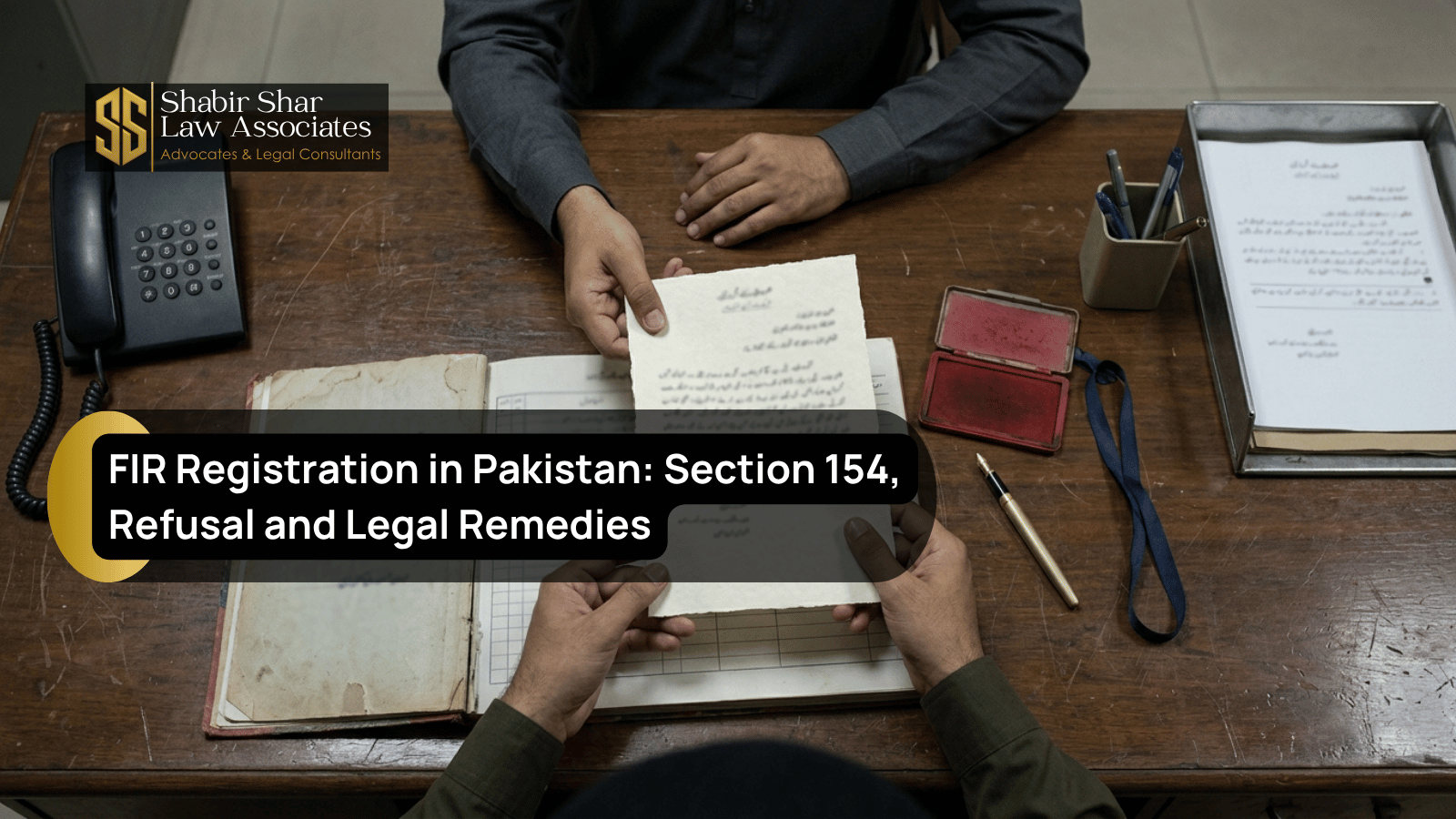
FIR Registration in Pakistan: What Section 154 CrPC Covers
An FIR is the formal recording of information relating to a cognizable offence under the criminal procedure framework. Section 154 of the Code of Criminal Procedure, 1898 addresses information given to the officer in charge of a police station about a cognizable offence and sets out how that information is to be recorded.
An FIR is important because it starts the formal criminal-investigation process, but it is not itself a judicial finding that every allegation is true. Investigation and any later court proceedings determine what evidence exists and what legal consequences follow.
What Information Should Be Communicated Clearly?
A complainant should focus on the material facts actually known: what happened, when and where it happened, who was involved if known, the nature of the alleged act and any immediately available supporting material. Speculation or invented detail can create serious problems later. Accuracy is more useful than trying to convert the complaint into technical legal drafting.
Documents, photographs, messages, medical records, ownership papers, transaction records, CCTV availability or witness details may be relevant depending on the allegation. Original material should be preserved carefully where possible.
What If the Police Do Not Register the Case?
Non-registration is not correctly explained by simply saying that every complainant should approach a Judicial Magistrate. Section 22-A of the CrPC gives an ex-officio Justice of the Peace powers that include issuing appropriate directions to police authorities on complaints concerning non-registration of a criminal case, among other specified police-related complaints.
The correct remedy depends on the facts and on whether the information actually discloses a cognizable offence. A section 22-A application should therefore present the complaint history and supporting material clearly rather than treating the proceeding as an automatic order for registration in every dispute.
For professional assistance with this issue, see our FIR registration legal service in Karachi.
Section 154 and Section 22-A Serve Different Functions
Section 154 concerns recording information about a cognizable offence at the police-station stage. Section 22-A provides specified powers to Justices of the Peace and includes the remedy relating to complaints of non-registration. Treating them as the same provision can confuse the procedural route.
The official text can be checked in the Code of Criminal Procedure, 1898 on Pakistan Code.
What Happens After an FIR Is Registered?
Registration is followed by investigation. Depending on the case, police may record statements, inspect places or property, collect documentary or electronic material, obtain medical or forensic evidence and take other lawful investigative steps. The investigating agency ultimately proceeds in accordance with the criminal procedure applicable to the matter.
If the case advances toward prosecution, our guide to the criminal trial process in Pakistan explains the broader sequence. If an accused person needs bail-related information, see the guide to pre-arrest and post-arrest bail.
Practical Records to Preserve Before Seeking a Remedy
Keep copies of the written complaint, any receiving or diary reference available, correspondence with police authorities, relevant documents and a basic chronology of attempts already made. If material was submitted electronically, preserve the transmission evidence. What is relevant will vary with the allegation.
Where urgency exists, legal advice should be based on the live status of the complaint or FIR rather than an old screenshot or assumption. A newly registered FIR can materially change the available procedure.
FIR Registration Matters in Karachi
For a Karachi matter, police-station jurisdiction, the place of the alleged occurrence and the current complaint history should be identified accurately. Local relevance should come from the actual facts and forum rather than adding Karachi repeatedly to otherwise generic content.
If registration leads to a contested prosecution, the related criminal trial service and bail services may become relevant depending on the person's role and procedural position.
Frequently Asked Questions
Is an FIR the same as proof of guilt?
No. An FIR records information and begins the investigation process. Guilt is not established merely because an FIR has been registered.
What does section 154 CrPC deal with?
Section 154 addresses information relating to a cognizable offence given to the officer in charge of a police station and the manner in which that information is recorded.
Who deals with a section 22-A complaint about non-registration?
The CrPC gives specified powers to an ex-officio Justice of the Peace, including on complaints concerning non-registration of a criminal case. The correct application depends on the facts and complaint history.
Should supporting evidence be preserved before making a complaint?
Yes. Relevant documents, communications, medical material, photographs, transaction records or witness information should be preserved where they genuinely relate to the allegation.
What happens after FIR registration?
The matter proceeds to investigation and may later move before the competent court according to the evidence, police report and applicable criminal procedure.
The firm publishes this guide as general legal information and identifies the legal framework and sources used where practical. A displayed review date is a content-review date; this page does not claim review by a named advocate unless that attribution is expressly shown. Matter-specific advice requires review of the current law, facts and documents.