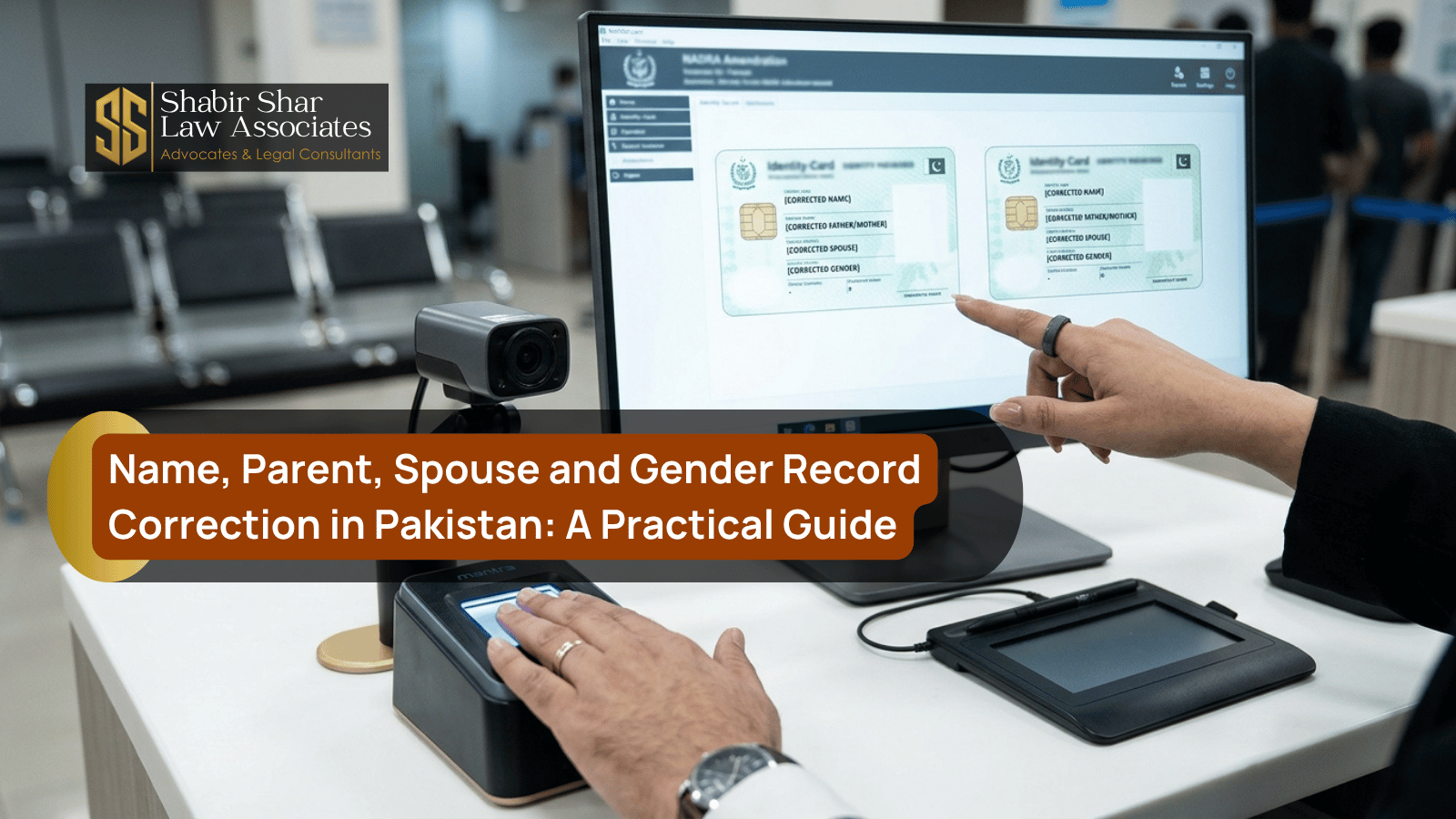
Name, Parent, Spouse and Gender Record Correction in Pakistan: A Practical Guide
A practical framework for correcting personal name, parent, spouse and gender-related discrepancies across NADRA and connected official records.
One Identity Error Can Appear Across Many Documents
A spelling difference in a personal name, an incorrect father or mother name, a spouse-detail mismatch or a gender-related identity discrepancy can spread across CNIC, CRC, passport, education, employment and financial records. The solution should begin with the source of the data rather than changing documents in an arbitrary order.
NADRA currently recognizes modification as a service category for CNIC and CRC through its official PakID framework. However, the evidence required for a particular field depends on the nature of the requested change and NADRA's current registration policy.
Personal Name Correction
A personal-name discrepancy may be as simple as a spelling inconsistency or as significant as a claimed change of legal identity. Compare the earliest reliable record with later documents and identify whether the issue is clerical, transliteration-related, family-record related or a substantive name change.
For legal assistance where the discrepancy is contested or extends across several authorities, review our name correction service in Karachi.
Father, Mother and Spouse Details
Family-detail corrections require attention to the relationship records that support the requested entry. A father or mother name may be reflected in birth and family-registration records; spouse details may depend on marital-status documentation and linked identity records. The correct sequence can differ where one family member's own record is already inaccurate.
See our father, mother and spouse-name correction service for disputes requiring legal review.
Gender-Related Identity Record Corrections
Gender-related identity records should be handled accurately, respectfully and according to the current NADRA process and applicable law. The exact route and evidence can be fact-specific, so outdated third-party checklists should not be treated as authoritative. Start with NADRA's current service information and preserve any written direction or decision received from the authority.
For a matter that remains legally disputed or inconsistent across records, review our gender and sex record correction service.
Build a Record-Matching Table Before Applying
A simple comparison table can prevent repeated applications. List each relevant document, the exact version of the disputed field shown on it, the issuing authority and the date of issue. Then identify which record has the strongest legal or documentary basis for the correct fact.
- NADRA CNIC/NICOP or CRC record.
- Birth registration or other foundational civil record.
- Parent or spouse identity record where relationship data is relevant.
- Marriage or family-status documentation where applicable.
- Passport or immigration record.
- Matriculation, intermediate, university or professional records.
Administrative Correction Should Usually Be Tested Before Litigation
Where the issuing authority has an established modification process, use it with coherent supporting documents and keep evidence of the outcome. A court declaration can be important where legal character or status is genuinely denied or where an authority cannot resolve the dispute administratively, but filing a declaratory suit should not be treated as a routine replacement for an available correction procedure.
The federal Specific Relief Act, 1877 provides the general declaratory-relief framework in section 42. Whether that relief is appropriate depends on the disputed legal character or right and the other relief available in the particular case.
After the Root Record Is Corrected
Update downstream records systematically. A correction accepted by NADRA does not automatically update a university, employer, bank or property record. Use the corrected foundational document to support separate applications where required and keep copies of previous and corrected versions to explain the documentary history.
Frequently Asked Questions
Can I correct my name on a CNIC through NADRA?
NADRA provides a CNIC modification category. The supporting requirements depend on the nature of the name change or discrepancy and the current NADRA policy.
What if my father's name is different on my CNIC and certificate?
Identify which record contains the source error first. Depending on the facts, either the identity record, educational record or both may require separate administrative correction.
Can spouse details be updated without changing every other document first?
The sequence depends on the underlying marital-status and identity records. Use the current issuing-authority requirements rather than assuming a universal document order.
Does every gender-record correction require court proceedings?
No universal answer should be assumed. NADRA has an identity-document modification framework, while legal proceedings may become relevant in a disputed or unresolved case depending on the applicable law and facts.
Why is a document comparison table useful?
It shows where the inconsistency began, prevents contradictory applications and helps identify which authority should be approached first.
This guide is written for general information and reviewed against the legal framework identified in the article. Laws, procedures and facts can change; confirm the current position before relying on information for a live matter.

Muhammad Saleem
Founder, Made by Saleem | Web Systems, SEO & Digital Growth SpecialistMuhammad Saleem is the founder of Made by Saleem and a web systems, SEO and digital growth specialist with 7+ years of practical experience. His work spans custom websites, Laravel and Filament platforms, CRM and client portals, ecommerce, business automation, SEO and digital marketing, with 50+ projects managed across multiple industries.
View author profile