Educational Certificate Correction in Pakistan: Board, University and Legal Routes
A practical guide to correcting names and personal details in board and university records, including record matching, administrative requests and legal escalation.
Start With the Institution That Issued the Record
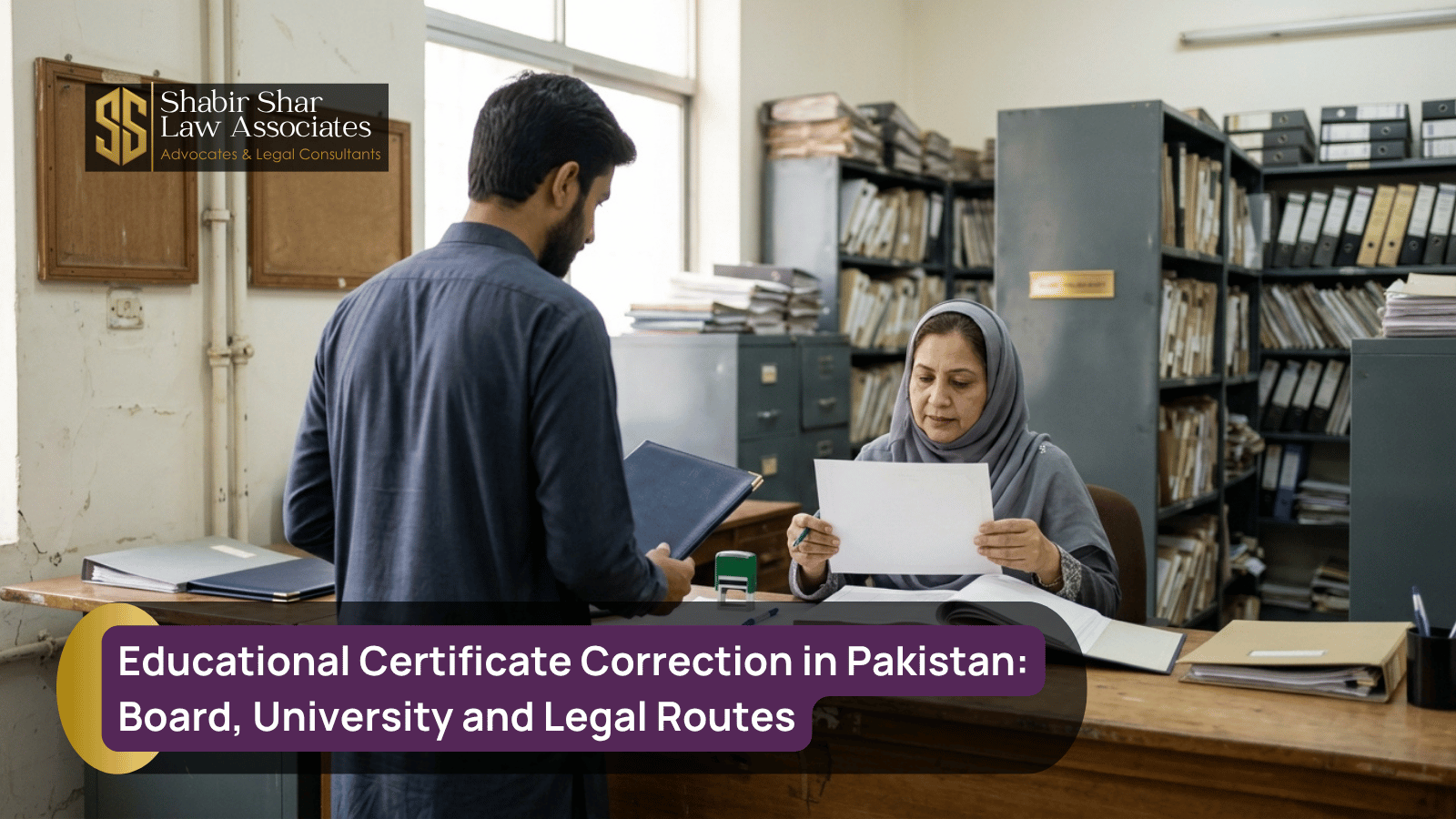
An educational certificate is maintained by the board, university or examining body that issued it. A CNIC correction does not automatically alter a matriculation certificate, intermediate record, university enrolment file or degree. The educational institution normally has to process its own record according to its rules and documentary requirements.
This is why educational correction should begin with the issuing authority's current procedure rather than a generic court template. Requirements can vary between boards, universities, examination years and the type of discrepancy involved.
Identify Whether the Error Is in the Education Record or an Earlier Identity Record
Compare the certificate with the foundational records used at admission or enrolment. An educational institution may have copied the applicant's name, father's name or date of birth from a matriculation certificate, registration form or identity document. If the earlier source is wrong, changing only the final certificate can leave the underlying institutional record inconsistent.
University of Karachi enrolment materials, for example, require names and family particulars to correspond with prior academic and identity records, illustrating why a consistent documentary chain matters. The University's official examination information also shows that educational-document processing relies on enrolment, registration, marks and identity documentation.
Common Types of Educational Record Discrepancy
- Spelling or transliteration difference in the student's name.
- Father or parent-name mismatch.
- Date-of-birth inconsistency.
- Identity details changed after the educational record was issued.
- Different versions of the same name across matriculation, intermediate and university records.
- A corrected NADRA record that has not yet been reflected in academic records.
For legal assistance in Karachi, see our educational certificate correction service.
Step 1: Obtain the Current Correction Requirements
Ask the issuing board or university for the current correction or record-amendment procedure. Do not rely on a form or fee list from another institution. A board may require original certificates, previous registration records, an affidavit, a corrected identity document, a school or college record, verification from another authority or additional evidence depending on the requested change.
Where the matter concerns Karachi intermediate records, official Board of Intermediate Education Karachi forms show that certificate applications are tied to the student's name, father's name, CNIC and earlier SSC/HSC particulars. That relationship reinforces the importance of correcting the record chain consistently rather than treating the final certificate in isolation.
Step 2: Correct the Root Identity Record Where Necessary
If NADRA data itself is incorrect and the academic record merely reflects that incorrect data, it may be more efficient to resolve the identity record first. NADRA currently provides CNIC and CRC modification categories through its official PakID service information.
For CNIC-related discrepancies, review our CNIC correction service and the guide to CNIC and B-Form correction in Pakistan.
Step 3: Make a Traceable Administrative Application
Submit the required application with a coherent set of supporting records and keep a stamped receipt, tracking number or other proof. If the institution refuses the request, ask for the reason in a form that can later be reviewed. A verbal statement that “the record cannot be changed” is much harder to assess than a written decision referring to a rule or missing document.
When Can Court Relief Become Relevant?
If the issuing authority cannot resolve a genuine dispute about legal character, identity or entitlement through its administrative procedure, legal proceedings may become relevant. Section 42 of the Specific Relief Act, 1877 provides a declaratory framework concerning legal character or rights. The proper defendants, relief and forum depend on the particular dispute.
Court proceedings should not be presented as mandatory for every clerical correction. The administrative route and the institution's written position should be understood first wherever practical.
Correct Records in a Logical Sequence
Where multiple educational records are affected, the sequence can matter. A matriculation record may feed an intermediate record, which may then feed a university record. Correcting the earliest authoritative record first can make later applications easier, but the exact process depends on each institution's rules.
For a personal-name issue spanning several document types, see our name correction service. For a parent-name discrepancy, see family-detail correction.
Frequently Asked Questions
Does changing my CNIC automatically change my degree or certificate?
No. Boards and universities maintain separate records. You normally need to approach the issuing educational authority under its own procedure.
Should I correct matriculation, intermediate or university records first?
Identify where the discrepancy originated and how later records were derived. The earliest authoritative incorrect record is often important, but each institution's rules must be checked.
Do all boards and universities have the same correction requirements?
No. Requirements, forms, fees and evidence vary by institution and can change over time. Always use the issuing authority's current instructions.
Is a court declaration always required for educational certificate correction?
No. An administrative correction process should be considered first where available. Judicial relief becomes relevant where the legal dispute cannot be resolved administratively and the law supports the relief sought.
What should I keep if my correction request is refused?
Keep the application, supporting documents, receipt or tracking proof, correspondence and any written decision stating why the correction was declined.
This guide is written for general information and reviewed against the legal framework identified in the article. Laws, procedures and facts can change; confirm the current position before relying on information for a live matter.

Muhammad Saleem
Founder, Made by Saleem | Web Systems, SEO & Digital Growth SpecialistMuhammad Saleem is the founder of Made by Saleem and a web systems, SEO and digital growth specialist with 7+ years of practical experience. His work spans custom websites, Laravel and Filament platforms, CRM and client portals, ecommerce, business automation, SEO and digital marketing, with 50+ projects managed across multiple industries.
View author profile