CNIC and B-Form Correction in Pakistan: NADRA Modification and Record-Matching Guide
A practical guide to CNIC and B-Form/CRC correction through NADRA, identifying the source record, supporting documents and when legal escalation may be needed.
NADRA Provides a Modification Route for Identity Records
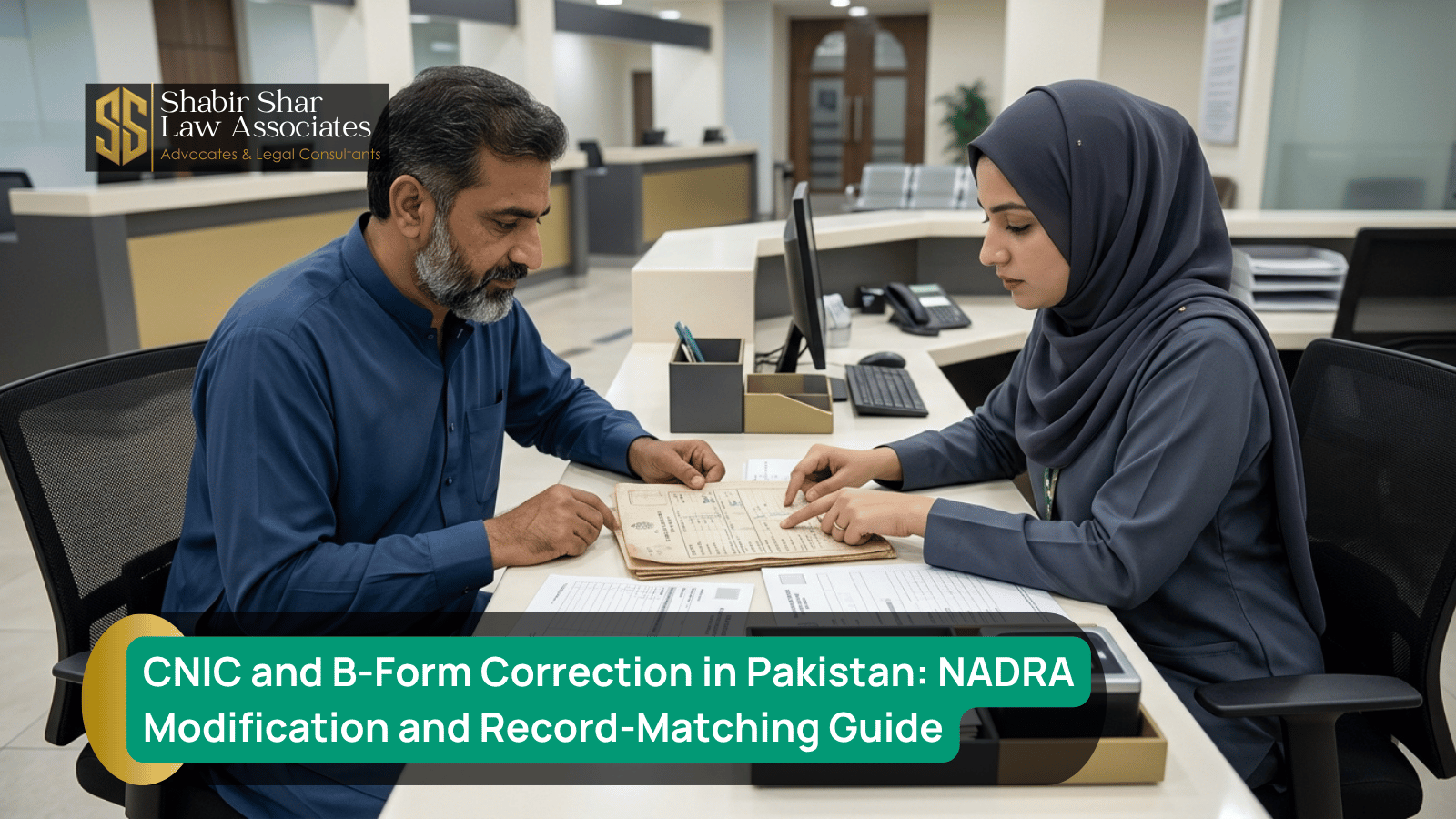
A discrepancy in a CNIC or Child Registration Certificate (CRC/B-Form) does not automatically require a civil suit. NADRA's current PakID FAQs list CNIC modification and CRC modification among the available application categories. NADRA also provides modification services through registration channels such as NADRA Registration Centres and its mobile services where applicable.
The practical starting point is to identify exactly which field is wrong, what the correct fact should be, and which source record supports that fact. A correction request is much easier to assess when the applicant can show a consistent documentary chain instead of presenting several records that contradict one another.
CNIC Correction and B-Form Correction Are Related but Different
A CNIC identifies an adult citizen, while a CRC records a child's registration particulars. A parent's own identity record can affect a child's family linkage, and a child's CRC can later influence educational or identity records. If the discrepancy is shared across family records, the correction sequence matters.
For adult identity issues, review the firm's CNIC correction service in Karachi. For a child record, see B-Form/CRC correction.
Step 1: Identify the Root Record
Before applying, compare the CNIC or CRC with the source documents relevant to the field in dispute. Depending on the correction, this may involve birth-registration material, family records, marriage or marital-status documentation, existing NADRA records, passports, educational documents or another authoritative record.
Do not assume that the document you want changed is necessarily the original source of the error. If the same incorrect name or date was copied from an earlier record, correcting only one downstream document can create a new mismatch.
Step 2: Use NADRA's Administrative Modification Process
NADRA's official service information confirms that modification is an established category for CNIC and CRC. The exact supporting documents and whether a matter can be completed online or requires a registration-centre visit depend on the document type, requested field and NADRA's current policy.
Use the official NADRA Services Charter and PakID FAQs rather than relying on old screenshots, agents or social-media lists of requirements. Fees and timelines also change; NADRA maintains a current fee and timeline page.
Step 3: Preserve the Application and Decision
If the correction is delayed, rejected or referred for further verification, keep the application tracking information, receipt, any written objection, verification request and supporting documents. A later legal review is much stronger when there is a clear record of what was requested and how the authority responded.
When Might Legal Assistance Be Needed?
Legal assistance may become relevant where the identity records are genuinely disputed, the supporting records conflict, an administrative request is refused despite a documented basis, or another authority requires a judicial declaration before it will act. The correct remedy depends on the underlying status or right in dispute.
Section 42 of the Specific Relief Act, 1877 concerns declaratory relief relating to legal character or rights. It should not be treated as a universal first step for every spelling or clerical error where the issuing authority has an available correction process.
Avoid Creating New Inconsistencies
After a successful correction, consider which connected records still carry the old particulars. Depending on the issue, this can include passport, bank, tax, education, employment, property or family records. Each institution has its own update process, and a corrected CNIC does not automatically rewrite every external database.
Frequently Asked Questions
Can CNIC details be modified through NADRA?
Yes. NADRA currently lists CNIC modification as an application category. The exact process and supporting evidence depend on the field being changed and current NADRA policy.
Can a B-Form or CRC be corrected?
NADRA currently lists CRC modification as an available category. Family-link and source-record issues may need to be resolved before the final correction is accepted.
Do I need a court decree for every CNIC correction?
No. NADRA has an administrative modification process. Court relief should be considered only where the legal and factual circumstances genuinely require it.
What should I do if NADRA rejects my correction?
Keep the written or trackable decision, identify the stated reason, review whether the supporting record is complete or conflicting, and then determine the appropriate administrative or legal remedy.
Will a corrected CNIC automatically update educational records?
No. Educational boards, universities and other institutions maintain their own records and procedures. You may need to apply separately to each relevant authority.
This guide is written for general information and reviewed against the legal framework identified in the article. Laws, procedures and facts can change; confirm the current position before relying on information for a live matter.

Muhammad Saleem
Founder, Made by Saleem | Web Systems, SEO & Digital Growth SpecialistMuhammad Saleem is the founder of Made by Saleem and a web systems, SEO and digital growth specialist with 7+ years of practical experience. His work spans custom websites, Laravel and Filament platforms, CRM and client portals, ecommerce, business automation, SEO and digital marketing, with 50+ projects managed across multiple industries.
View author profile