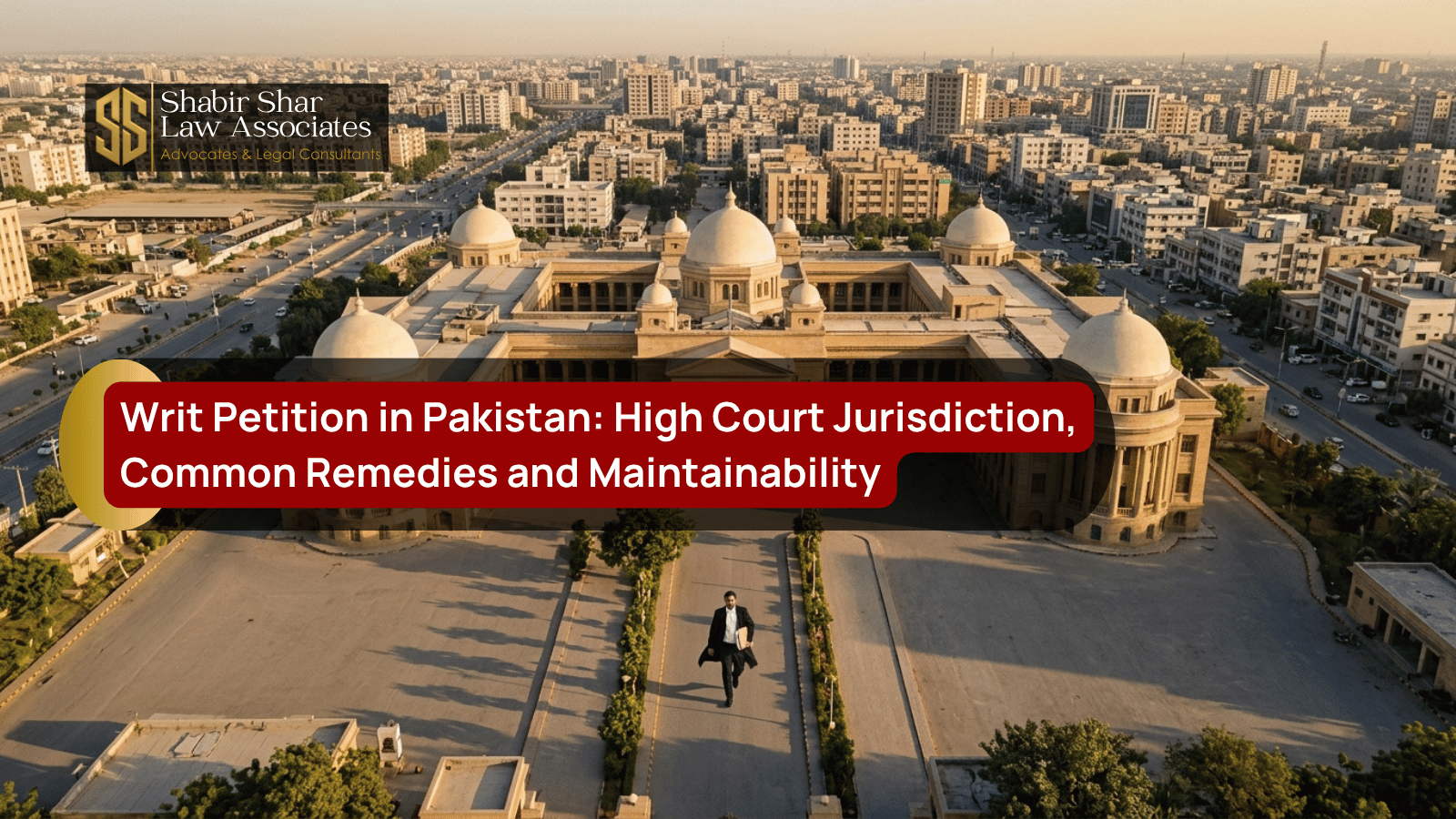
Writ Petition in Pakistan: High Court Jurisdiction, Common Remedies and Maintainability
A practical guide to writ petitions in Pakistan, explaining Article 199 jurisdiction, common writ-style remedies, maintainability and preparation for High Court proceedings.
What Does “Writ Petition” Mean in Pakistan?
In Pakistan, the expression “writ petition” is commonly used for an application invoking the constitutional jurisdiction of a High Court under Article 199. The Constitution is framed in terms of orders, directions and declarations rather than merely listing historic English writ names, but legal practice still uses terms such as mandamus, certiorari, prohibition, habeas corpus and quo warranto to describe the nature of relief.
The correct approach is to start with the current text of Article 199 and the legal problem, then identify the order the High Court is constitutionally empowered to make. Choosing a familiar writ label without matching the petition to the constitutional requirements can create maintainability problems.
Common Types of Writ-Style Relief
A petition may seek a direction requiring a public functionary to perform a duty imposed by law, an order restraining action that is not legally permitted, or a declaration that an act or proceeding has been taken without lawful authority and is of no legal effect. Article 199 also contains specific routes concerning unlawful custody and the authority by which a person holds public office.
For Fundamental Rights, Article 199(1)(c) permits appropriate directions to a person or authority, including Government, for enforcement of rights conferred by Chapter 1 of Part II of the Constitution.
Mandamus, Certiorari and Prohibition
“Mandamus” is commonly used where a petitioner seeks performance of a public legal duty. “Certiorari” is commonly associated with judicial review of an unlawful decision or proceeding, while “prohibition” is generally used for restraining a body from acting beyond lawful jurisdiction. These labels can be useful shorthand, but the petition should plead the actual statutory duty, jurisdictional defect or unlawful action rather than rely on the Latin expression alone.
Habeas Corpus and Quo Warranto
Article 199 expressly empowers a High Court, on the application of any person, to require that a person in custody within its territorial jurisdiction be brought before it so the Court can examine whether the custody is without lawful authority or in an unlawful manner. It also allows an order requiring a person holding or purporting to hold public office to show the authority of law under which that office is claimed.
These constitutional routes are fact-specific and can involve urgent procedural considerations. They should not be confused with ordinary bail, criminal trial or employment litigation.
Why Alternative Remedies Matter
Article 199 begins with an important limitation: the High Court must be satisfied that no other adequate remedy is provided by law. Where an appeal, review, tribunal or statutory process is available, a writ petition may face an objection unless the circumstances justify constitutional intervention.
This is one reason a legal notice, representation or departmental appeal cannot be treated as a routine box-ticking exercise. The governing statute, the authority's jurisdiction and the actual remedy available should be reviewed before filing.
Standing and the Person Who May Apply
The Constitution uses different standing language across Article 199. Some relief is available on the application of an “aggrieved party” or “aggrieved person,” while the custody and public-office provisions use broader language. A petition should therefore explain the applicant's connection with the challenged action and why the particular constitutional clause applies.
Current Constitutional Bench Structure
The constitutional architecture changed through the Twenty-Sixth and Twenty-Seventh Amendments. Article 202A now addresses Constitutional Benches of High Courts, while the current Constitution also establishes the Federal Constitutional Court and provides an appellate framework for certain Article 199 judgments. The operative bench and appeal route should be checked at the time of filing rather than copied from older precedents or websites without updating the constitutional position.
The National Assembly's current constitutional compilation is a useful primary reference.
Writ Petitions in Karachi
For a Karachi petition, territorial jurisdiction, the location of the respondent authority, the place where the impugned action occurred and the current High Court filing/bench arrangements should be confirmed. The requested relief should also be framed so it addresses the actual public-law problem rather than duplicating a civil or statutory remedy.
See our writ petition service in Karachi, constitutional petition service and Constitutional Law services. For the broader framework, read our Article 199 constitutional petition guide.
Frequently Asked Questions
Is a writ petition different from a constitutional petition?
In Pakistani practice, the terms often overlap because writ-style relief is commonly sought through Article 199 constitutional jurisdiction. The exact legal basis depends on the relief and facts.
Can a writ petition replace a statutory appeal?
Not automatically. The existence of another adequate remedy is a central Article 199 consideration.
Does the Constitution literally list all traditional writ names?
No. Article 199 describes the High Court's powers in terms of orders, directions and declarations, although traditional writ labels remain common legal shorthand.
Can a writ petition challenge private conduct?
Article 199 is primarily public-law jurisdiction. Whether a respondent falls within the constitutional framework depends on the function, authority and relief involved.
Why should old Article 199 guides be checked carefully?
Because constitutional amendments in 2024 and 2025 changed the bench and appellate architecture for constitutional matters.
This guide is written for general information and reviewed against the legal framework identified in the article. Laws, procedures and facts can change; confirm the current position before relying on information for a live matter.

Muhammad Saleem
Founder, Made by Saleem | Web Systems, SEO & Digital Growth SpecialistMuhammad Saleem is the founder of Made by Saleem and a web systems, SEO and digital growth specialist with 7+ years of practical experience. His work spans custom websites, Laravel and Filament platforms, CRM and client portals, ecommerce, business automation, SEO and digital marketing, with 50+ projects managed across multiple industries.
View author profile