Fundamental Rights in Pakistan: Constitutional Protections and Article 199 Remedies
An accessible guide to Fundamental Rights in Pakistan and how Article 199 may be used to seek constitutional enforcement, subject to jurisdiction and available remedies.
Where Are Fundamental Rights Found in Pakistan's Constitution?
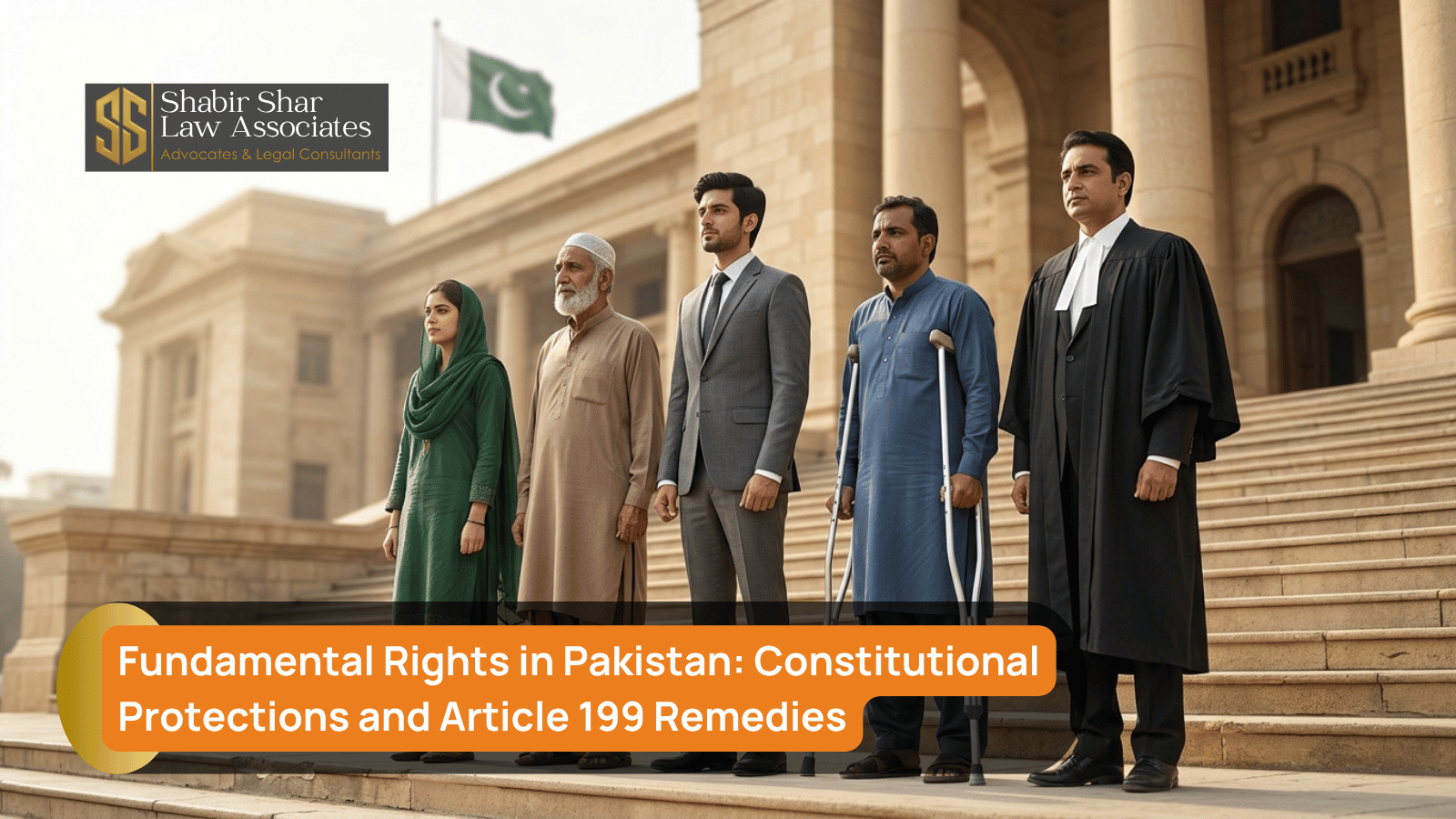
Fundamental Rights are set out in Chapter 1 of Part II of the Constitution of Pakistan. They include constitutional protections relating to life and liberty, safeguards as to arrest and detention, fair trial and due process, dignity, movement, assembly, association, speech and information, religion, property, equality and education, among other rights.
These rights must be read in their full constitutional text because several are subject to lawful restrictions, qualifications or specific procedures. A short social-media summary cannot establish whether a particular restriction is constitutionally valid.
Article 199 and Enforcement of Fundamental Rights
Article 199(1)(c) allows a High Court, on the application of an aggrieved person, to give appropriate directions to a person or authority, including Government, for enforcement of Fundamental Rights within the Court's jurisdiction. Article 199(2) further protects the right to move a High Court for enforcement of those rights, subject to the Constitution.
This does not mean every dispute involving a broad concept such as fairness becomes a Fundamental Rights case. The petition should identify the specific constitutional right, the conduct that allegedly violates it, the respondent's legal character, territorial jurisdiction and the order required to address the violation.
Examples of Constitutional Protections
Article 9 concerns security of person; Article 10A provides for fair trial and due process; Article 14 protects the dignity of man and privacy of home subject to law; Articles 15 to 17 address movement, assembly and association; Articles 19 and 19A concern freedom of speech and access to information subject to constitutional limits; Articles 20 to 22 address religious protections; Articles 23 and 24 concern property; Article 25 addresses equality of citizens; and Article 25A concerns education.
The legal test under any of these provisions depends on the text, applicable legislation and facts. For example, a lawful regulatory restriction may raise a very different question from action taken without statutory authority.
Fundamental Rights and Public Authorities
Many constitutional cases involve a decision, omission, notification, policy or exercise of statutory power by a public authority. The legal analysis usually asks what power the authority had, whether mandatory procedure was followed, whether the decision stayed within jurisdiction, and whether a protected constitutional right was affected.
A strong petition therefore relies on the governing law and record, not only broad constitutional language.
Alternative Remedies Still Matter
Article 199 jurisdiction is expressly linked to the absence of another adequate remedy provided by law. If a specialist tribunal, appeal, review or other statutory mechanism exists, the petitioner must consider its effect on maintainability. The existence of a Fundamental Rights argument does not automatically erase every statutory forum issue.
Current Constitutional Structure After 2024–2025 Amendments
The current constitutional framework includes Constitutional Benches provisions and a Federal Constitutional Court established by later amendment. Certain constitutional appeals now follow the amended structure. Anyone preparing a petition in 2026 should therefore work from the current Constitution rather than older material describing the Supreme Court/High Court framework before those amendments.
The Constitution published by the National Assembly is amended up to 21 November 2025.
Preparing a Rights-Based Constitutional Case
Preparation commonly includes identifying the exact constitutional provision, collecting the challenged order or communication, obtaining the law/rules governing the authority, preparing a chronology, documenting representations already made, and assessing whether an alternative remedy exists. If urgent interim relief is requested, the factual basis for urgency and likely consequences should be documented.
Karachi Constitutional Matters
For a matter connected with Karachi, the High Court of Sindh may be the relevant constitutional forum depending on territorial jurisdiction and the nature of the challenged action. Current bench arrangements and the correct respondent authority should be checked before filing.
For representation, see our constitutional petition service, writ petition service and public interest litigation service. The companion writ petition guide explains common writ-style remedies and maintainability.
Frequently Asked Questions
Are Fundamental Rights absolute?
Not all are absolute. The constitutional text itself contains qualifications and lawful restrictions for several rights.
Can a High Court enforce Fundamental Rights?
Yes. Article 199(1)(c) provides a constitutional route for appropriate directions to enforce Fundamental Rights, subject to jurisdiction and maintainability.
Is unfair treatment automatically a constitutional violation?
No. A constitutional claim should identify a specific protected right and legally attributable conduct that infringes it.
Do alternative remedies matter in a rights petition?
Yes. The Article 199 framework still requires careful consideration of other adequate remedies provided by law.
Why is current constitutional text especially important in 2026?
Because amendments in 2024 and 2025 changed parts of the constitutional bench and appellate structure.
This guide is written for general information and reviewed against the legal framework identified in the article. Laws, procedures and facts can change; confirm the current position before relying on information for a live matter.

Muhammad Saleem
Founder, Made by Saleem | Web Systems, SEO & Digital Growth SpecialistMuhammad Saleem is the founder of Made by Saleem and a web systems, SEO and digital growth specialist with 7+ years of practical experience. His work spans custom websites, Laravel and Filament platforms, CRM and client portals, ecommerce, business automation, SEO and digital marketing, with 50+ projects managed across multiple industries.
View author profile