Major Penalty, Compulsory Retirement and Reinstatement in Sindh Service Law
A service-law guide to disciplinary penalties, compulsory retirement, removal from service and possible reinstatement remedies for Sindh civil servants.
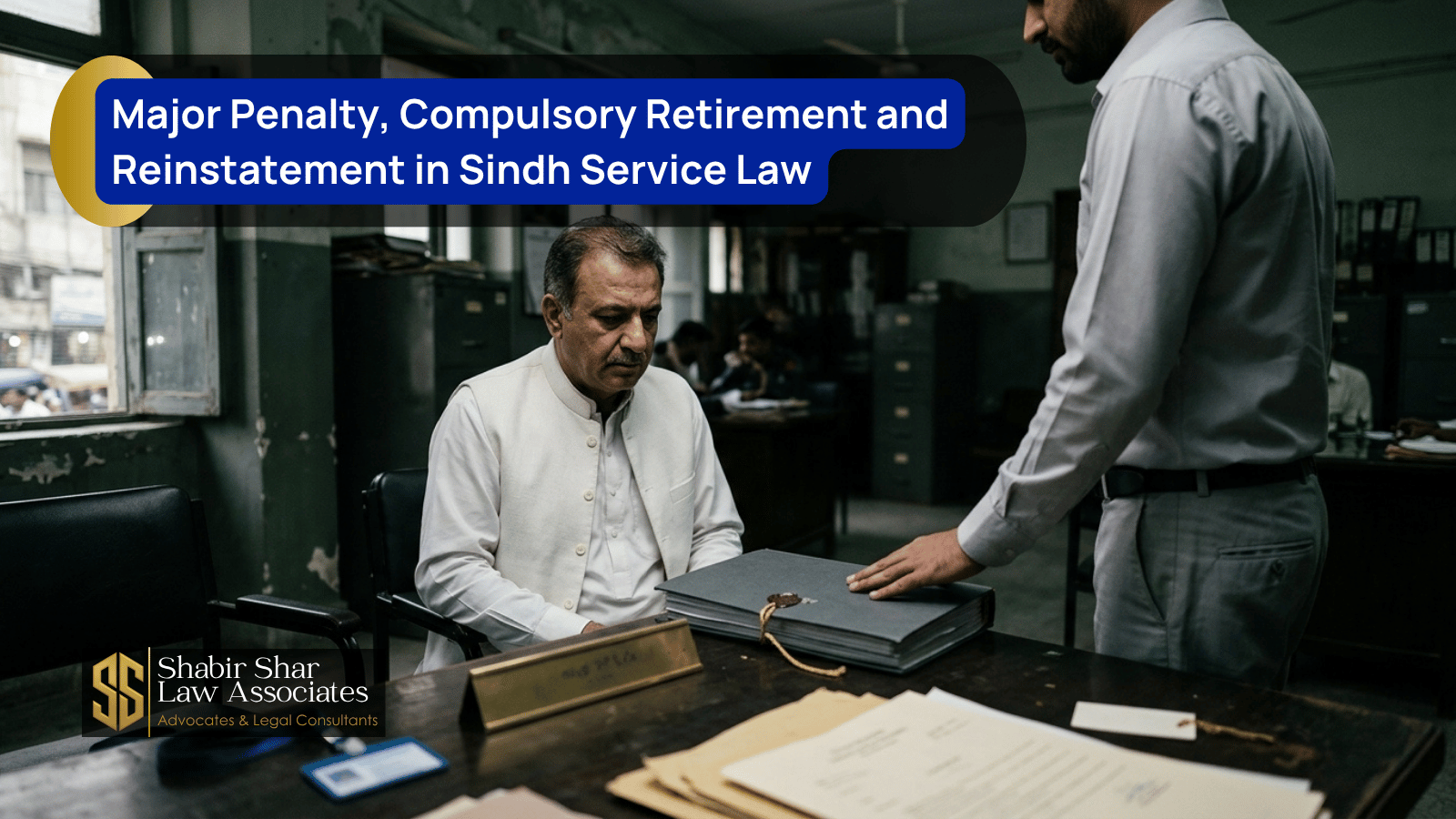
Start by Identifying the Legal Nature of the Order
A civil servant who loses a post, is compulsorily retired or receives another serious penalty needs to identify the legal source of the order before choosing a remedy. Similar practical consequences can arise under different provisions: a disciplinary penalty, termination during probation, reversion, public-interest retirement, or another service order may each follow a different legal route.
The Sindh Civil Servants Act, 1973 is an important starting point. Section 17 provides that a civil servant is liable to prescribed disciplinary action and penalties in accordance with the prescribed procedure. Section 13 separately addresses retirement from service, including the current statutory framework for retirement in the public interest and the requirement, in the circumstances stated by that section, to inform the civil servant in writing of the proposed grounds and provide a reasonable opportunity to show cause.
Why “Compulsory Retirement” Must Be Classified Carefully
The phrase compulsory retirement may be used in different service-law contexts. A retirement direction under the statutory retirement provision should not automatically be treated as identical to a disciplinary penalty carrying the same practical result. The order itself, the cited law, the proceedings leading to it and the competent authority should be reviewed.
The current Sindh Civil Servants Act was amended in 2024 in relation to retirement and pension arrangements. Older templates or advice can therefore be misleading if they assume the pre-amendment wording continues unchanged.
For a case-specific review in Karachi, see our compulsory retirement service.
Disciplinary Procedure and the Record of Allegations
Where an adverse order is disciplinary, collect the charge or show-cause notice, statement of allegations, inquiry material, defence submitted, evidence relied upon and the final speaking order. The applicable efficiency and discipline framework may vary according to the employee's service, institution and rules, so the exact instrument should be identified rather than assumed.
Potential legal issues can include jurisdiction of the authority, failure to follow mandatory procedure, denial of an opportunity to respond, reliance on irrelevant material, inconsistency between the charge and the final finding, or a penalty imposed under an inapplicable rule. Whether any such issue actually invalidates an order depends on the law and facts.
See the firm's major penalty service in Karachi for disciplinary-order review.
Restoration or Reinstatement Is a Remedy, Not an Automatic Result
When a dismissal, removal, termination or retirement order is successfully challenged, the consequences still need to be determined under the governing law. Restoration to service, continuity, back benefits, seniority and pension consequences are distinct questions. A successful challenge does not mean every financial or service benefit follows automatically in every case.
For employment restoration issues, review our restoration in employment service. If the order affects ranking or career progression, the seniority service or promotion service may also become relevant.
Departmental Remedies and Service Tribunal Timing
Section 23 of the Sindh Civil Servants Act addresses departmental appeal, review or representation in service matters. The Sindh Service Tribunals Act then governs appeals to the Tribunal from qualifying final orders. In many cases, the chronology of departmental and Tribunal remedies is as important as the merits of the disciplinary challenge.
See our detailed guide to Sindh Service Tribunal appeal procedure for the interaction between final orders, departmental remedies and limitation.
What to Preserve Immediately After an Adverse Order
- The complete final order and proof of communication.
- Appointment, confirmation and promotion history.
- The exact service and disciplinary rules cited by the department.
- Show-cause notice, charge sheet or statement of allegations.
- Written defence, inquiry report and evidence supplied to the employee.
- Previous departmental appeal, review or representation.
- Pay, seniority and pension records if consequential benefits may be affected.
Avoid Treating Every Termination as the Same Case
A probationary termination, contractual non-renewal, disciplinary removal, compulsory retirement and termination of a regular civil servant can involve materially different legal questions. The employee's status and the source of power used by the authority should be confirmed first. This is particularly important for employees of autonomous bodies, statutory corporations and universities, where a separate service regime may apply.
Frequently Asked Questions
Is compulsory retirement always a disciplinary penalty?
No. An order described as compulsory or public-interest retirement must be read with the provision under which it was made. Classification of the order affects procedure and remedy.
Can a civil servant challenge a major penalty?
Potentially yes, through the remedies available under the applicable service law and rules. The correct departmental and Tribunal route, limitation and jurisdiction must be checked.
Does reinstatement automatically include back pay?
No. Restoration, continuity, back benefits, seniority and pension consequences should be treated as separate legal questions governed by the applicable order and law.
What if I was not given an opportunity to respond?
Procedural fairness can be important, but the effect depends on the governing provision, the process actually followed and the nature of the order. Preserve all notices and replies for review.
Why should an adverse service order be reviewed quickly?
Departmental and Tribunal remedies can be time-sensitive. Delay can create limitation issues even where the employee believes the underlying order is unlawful.
This guide is written for general information and reviewed against the legal framework identified in the article. Laws, procedures and facts can change; confirm the current position before relying on information for a live matter.

Muhammad Saleem
Founder, Made by Saleem | Web Systems, SEO & Digital Growth SpecialistMuhammad Saleem is the founder of Made by Saleem and a web systems, SEO and digital growth specialist with 7+ years of practical experience. His work spans custom websites, Laravel and Filament platforms, CRM and client portals, ecommerce, business automation, SEO and digital marketing, with 50+ projects managed across multiple industries.
View author profile