Cancellation of Documents in Pakistan: Section 39, Declarations and Civil Court Relief
A practical guide to cancellation of written instruments in Pakistan under section 39 of the Specific Relief Act, including registered documents and related declaratory relief.
When Can a Written Instrument Be Cancelled?
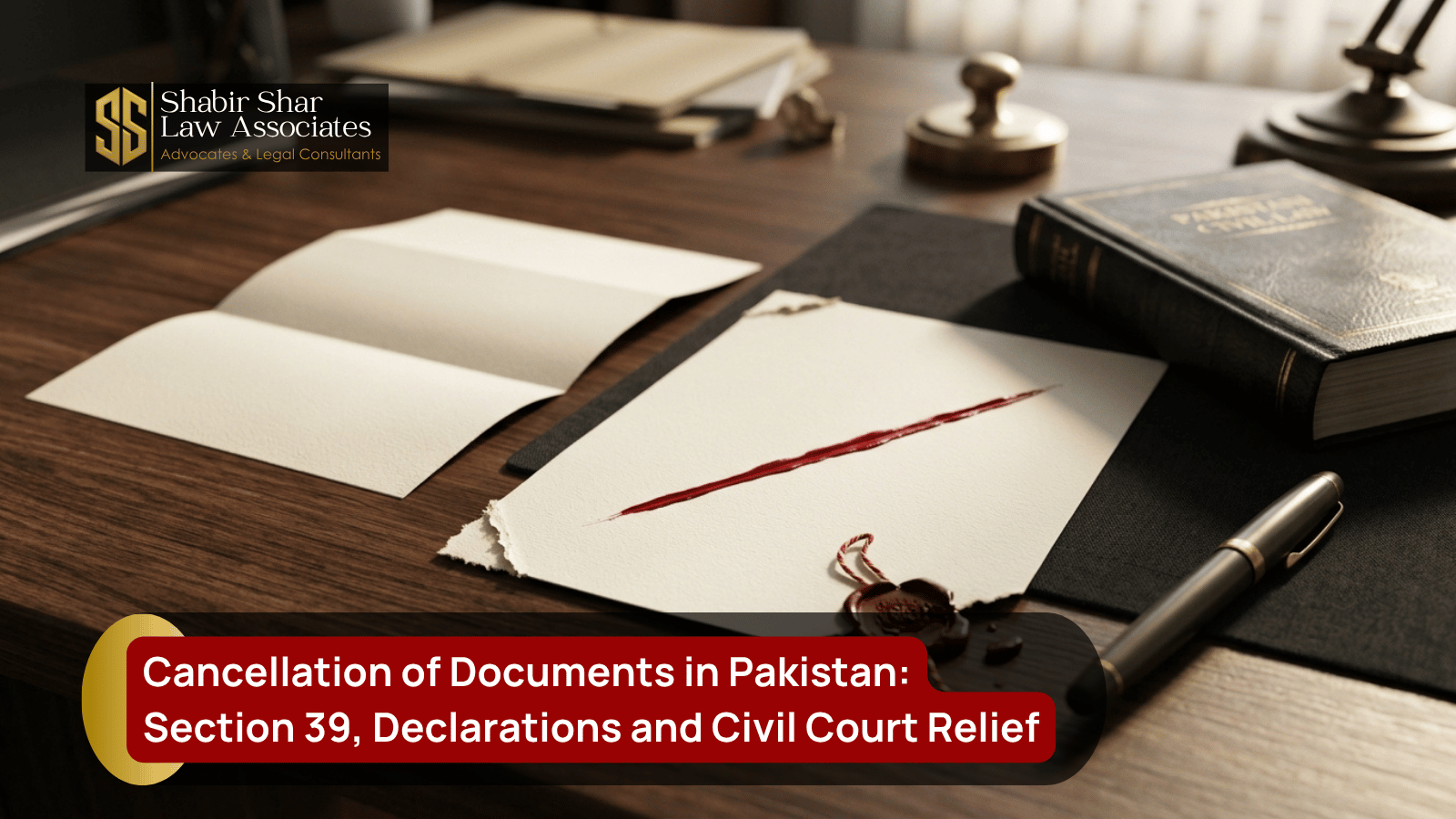
Section 39 of the Specific Relief Act, 1877 deals with cancellation of written instruments. It provides a civil remedy where an instrument is void or voidable against a person and that person has reasonable apprehension that leaving it outstanding may cause serious injury. The court may, in its discretion, adjudge the instrument void or voidable and order it delivered up and cancelled.
This remedy is more specific than simply asking a court to say that a document is “wrong.” The plaintiff should identify the instrument, explain why it is legally void or voidable against them, and show why its continued existence creates a real legal risk.
Void and Voidable Documents Are Not the Same
A void instrument is treated as having no legal validity in the relevant sense, while a voidable instrument may remain operative unless and until it is avoided through the appropriate legal process. Which description applies depends on the transaction, authority, consent, fraud, misrepresentation, legal capacity and other governing law.
Online labels should not replace analysis of the actual instrument and underlying transaction.
What Happens If the Instrument Is Registered?
Section 39 expressly addresses registered instruments. Where a registered instrument is cancelled, the statutory framework requires the court to send a copy of its decree to the relevant registration officer so the cancellation can be noted against the registered copy.
This is an important reason not to treat a private letter or informal notice as equivalent to a civil-court cancellation decree where a registered instrument continues to affect title or rights.
Cancellation vs Declaration
Section 42 of the Specific Relief Act deals with declarations of legal character or rights to property. In some disputes, declaratory relief may be central; in others, the continued existence of a void or voidable instrument makes cancellation the necessary remedy. Some cases may require both cancellation and consequential relief.
The prayer clause should be designed around the actual legal consequences of the document, not a generic template.
Documents Commonly Reviewed Before Filing
Depending on the dispute, useful records may include the original or certified copy of the instrument, registration details, title or ownership records, transaction documents, payment evidence, signatures, authority documents, correspondence, notices and any earlier proceedings. If fraud, coercion, lack of authority or another specific ground is alleged, the pleadings and evidence should address that ground precisely.
Limitation and Delay
Document disputes can raise limitation questions. The relevant period depends on the relief and facts, including when the claimant became entitled to sue or acquired knowledge of the issue under the applicable limitation framework. Limitation should therefore be reviewed immediately rather than assumed from a generic internet timeline.
Temporary Protection While the Suit Is Pending
If there is a risk that the disputed instrument will be acted upon, transferred, used to alter possession or otherwise cause immediate prejudice, the plaintiff may need to consider interim relief under the CPC. Temporary injunction requirements are separate from the final test for cancellation.
Official Legal Source
The Specific Relief Act, 1877 published on Pakistan Code contains section 39 on cancellation and section 42 on declaratory decrees.
Document Cancellation Suits in Karachi
For Karachi matters, the correct court depends on subject matter, valuation, territorial jurisdiction and the legal effect of the instrument. Where immovable property is involved, the location of the property and registration record may be particularly important.
See our cancellation of documents service in Karachi and Civil Litigation services. Where the dispute concerns status or continuing interference rather than cancellation alone, review our declaration and permanent injunction guide.
Frequently Asked Questions
Can every incorrect document be cancelled under section 39?
No. Section 39 addresses written instruments that are void or voidable against the claimant and whose continued existence creates a reasonable apprehension of serious injury.
What if the document is registered?
The Act provides for the decree of cancellation to be communicated to the registration officer so the registered record can reflect the cancellation.
Is cancellation the same as declaration?
No. Cancellation attacks the continued legal existence/effect of an instrument; declaratory relief determines legal status or rights. The appropriate remedy depends on the dispute.
Can temporary relief be sought while cancellation proceedings are pending?
Potentially, where the CPC requirements for interim relief are satisfied. Interim protection is discretionary and case-specific.
What should be checked before filing in Karachi?
Review the instrument, registration status, legal ground for invalidity, consequential relief, limitation, valuation, jurisdiction and any immediate risk requiring interim protection.
This guide is written for general information and reviewed against the legal framework identified in the article. Laws, procedures and facts can change; confirm the current position before relying on information for a live matter.

Muhammad Saleem
Founder, Made by Saleem | Web Systems, SEO & Digital Growth SpecialistMuhammad Saleem is the founder of Made by Saleem and a web systems, SEO and digital growth specialist with 7+ years of practical experience. His work spans custom websites, Laravel and Filament platforms, CRM and client portals, ecommerce, business automation, SEO and digital marketing, with 50+ projects managed across multiple industries.
View author profile